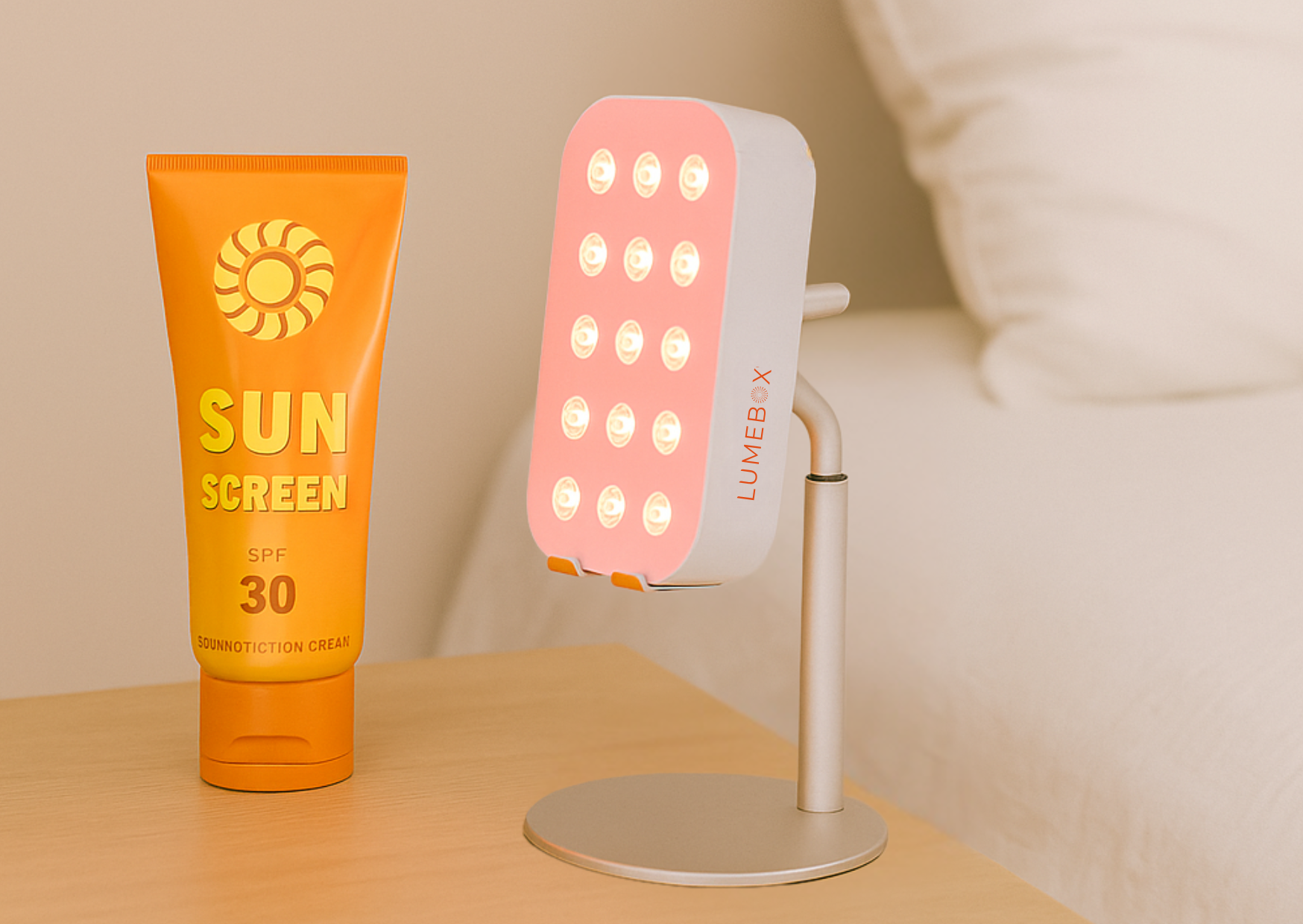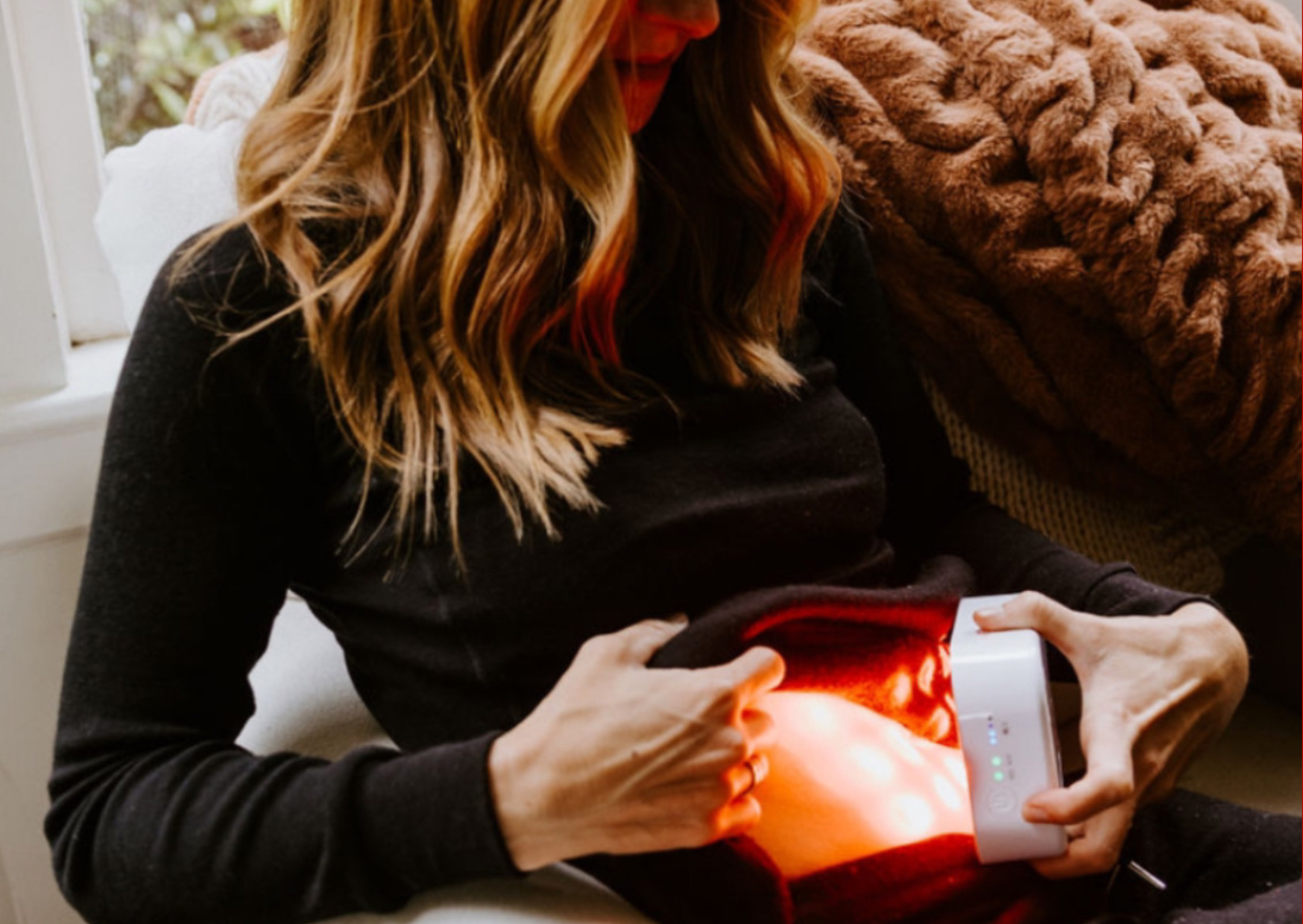
Red light therapy is all the rage in skincare right now (anyone else spot that red glow in Devil Wears Prada II?). But beyond the trend, there's also a growing body of research suggesting that red and near-infrared (NIR) wavelengths may support the appearance of healthy skin (as well as happier-feeling joints and muscles!).
But if you're using red light therapy as part of your skincare routine, do you need to worry about your sunscreen interfering with it? Could SPF be blocking those beneficial red and NIR wavelengths?
We break it down for you below.
Is Sunlight Beneficial?
The sun has been a health resource for humans throughout our entire evolution, supporting bone health, immune function, blood sugar regulation, and more. [1] So it's actually beneficial if we approach it sensibly.
That said, more sun exposure also means more UV exposure and more risk for our skin:
- DNA damage
- Break down of collagen & elastin → signs of skin aging
- Suppression of immune responses in the skin
- Skin cancer
We’re not advocating for avoiding the sun completely, but it makes sense to be smart about how we get our light. The good news? UV isn't the only thing the sun has to offer.
The Power of Red and Near-Infrared Light
Two specific wavelengths within the sun's spectrum have the ability to penetrate the skin and reach the mitochondria inside our cells.
Red light therapy concentrates those beneficial wavelengths and delivers them at a higher intensity, without the UV damage that comes with sun exposure.
When those wavelengths reach your skin, they're picked up by receptors inside your cells' mitochondria (your cells' tiny power plants), kickstarting energy production and better blood flow.
Studies have shown that red light therapy may support:
- Healthy-looking skin [2,3]
- Temporary relief from minor aches and discomfort [4,5]
- Temporary relief from post-workout muscle soreness [6,7]
And so much more!
If you use red light as part of your skincare routine, you may have wondered: does sunscreen get in the way?
Can Sunscreen Block Red and NIR Wavelengths?
The bottom line:
- If your goal is to benefit from RED light, skip the sunscreen before using red light therapy. Both chemical and mineral formulas could block some of it.
- NIR (near-infrared) is largely unaffected, but red wavelengths are more vulnerable.
- Mineral sunscreen is likely to block more than chemical.
For those of you who want to know where this information came from and the science behind it all, read our deep dive below!
The Science: How Sunscreen Interacts With Red and NIR Light
The graph below simplifies which wavelengths are blocked/absorbed/reflected by chemical and mineral sunscreens, based on published ingredient absorption spectra.
Chemical sunscreens generally absorb up to 400nm (UV light) with minimal activity near the red or near-infrared range. Mineral sunscreens have a broader, more gradual taper, blocking some red wavelengths — but by the time you reach NIR wavelengths (700nm+), blocking is minimal.
Worth noting: LUMEBOX is third-party tested to emit 660nm red light and 850nm near-infrared light. Red is in the range where sunscreen may interfere with light penetration. NIR light is largely unaffected!

Let's break down each sunscreen type and exactly how it interacts with different wavelengths.
Chemical vs. Mineral: How Each Blocks Light
There are 2 main types of sun protection that you’ll find in your local drugstore:
- Chemical sunscreen
- Mineral sunblock
Chemical sunscreen:
- Absorbs UV light [8]
- Invisible and lightweight application

Most chemical sunscreens contain compounds like oxybenzone that absorb UV light, with absorption dropping off sharply around 400 nm. [9] They do not meaningfully absorb red or near-infrared light.

Some newer-generation chemical sunscreen ingredients have absorption ranges that extend slightly closer to 600nm, meaning a tiny fraction of shorter red wavelengths could theoretically be partially blocked. [10]
Mineral sunblock:
- Blocks / scatters / reflects UV rays [11]
- Often leaves a visible white layer on the skin

Mineral sunscreens contain ingredients that may physically block UV wavelengths, like titanium dioxide and zinc oxide.
This interaction drops off around the UV–visible boundary (~400 nm), meaning they don’t specifically block red and near-infrared light wavelengths. [12]

However, when these minerals are measured in real sunscreen formulations applied to skin, they can still increase back-scattering of longer wavelengths.
Another study suggested that zinc oxide may absorb small portions of light up to 800nm: [13]

So while neither sunscreen type is designed to block red or NIR light, the interaction is more nuanced in practice, especially with thicker mineral formulas.
TL;DR: Will Sunscreen Dampen Red Light Therapy Results?
The short answer: almost certainly not in any meaningful way.
Sunscreens are not designed to block red or near-infrared light, and for the most part, they don't.
- 660–850nm sit within the range of light that penetrates deepest through tissue.
- Chemical sunscreens absorb into the skin quickly and don't remain as a surface barrier (this works in your favor if you apply RLT shortly after).
- Some newer chemical ingredients (like BDBP) have absorption that extends toward 600nm, which could marginally affect the very shortest red wavelengths (this is a minor edge case, not a reason to skip sunscreen).
- Mineral sunscreens with zinc oxide / titanium dioxide may scatter a small fraction of red light wavelengths as they sit on the surface. (The expected impact is minor given how deeply red and NIR light penetrate).
- If you're only using NIR light for your skin, the good news is that sunscreen is unlikely to get in the way in any meaningful way. That said, one 2019 study [14] on 155 women found that mineral sunscreens containing zinc oxide and titanium dioxide did scatter some near-infrared light. (You can tell if your sunscreen is higher in these minerals by how white and chalky it looks on your skin.)
For the best of both worlds: use your LUMEBOX first, then apply sunscreen.
But if the choice is between skipping red light therapy or using it on a sunscreened face, use red light! You’ll still be getting ~95%+ of the benefits even in a worst-case scenario.
Our Routine: Using Red Light Therapy and Sunscreen Together
Timing
- Use LUMEBOX in the morning on your face, before putting on sunscreen and heading outside.
- Apply your sunscreen after your RLT session, once your skin has settled.
- If you're using LUMEBOX in the evening, remove makeup and cleanse your face first, then use LUMEBOX on clean skin.
A fascinating pilot study worth knowing about:
Could red light therapy help our skin resist UV damage?
The 2008 study [15] explored whether pre-treating skin with 660nm red LED light before UV exposure could help the skin build resistance to sunburn. While the study did not use LUMEBOX, it used a research-grade LED device operating at the same red wavelength (660 nm) and within a comparable irradiance range.Here's what they found:
-
- 15 participants received 5–10 red LED treatments on one thigh (60 mW/cm², 160 seconds, 5 J/cm²), with the other thigh left untreated
- 24 hours after UV exposure, 85% showed significantly less sunburn on the treated side, which required more UV intensity to produce the same redness
- Researchers observed a reduction in post-inflammatory hyperpigmentation at higher UV doses
Gentle reminder: Of course, this does not mean that LUMEBOX or any red light device should replace your sunscreen!
Skin Prep
- Start with clean, hydrated skin. Having any product on your skin affects how light interacts with the surface.
Use first thing in the morning, or after cleansing oily products from skin.
If your skin feels dry after cleansing, apply a lightweight water-based moisturizer first. Research suggests well-hydrated skin may actually allow more light to penetrate, so this step is a win-win. [16]
- Use LUMEBOX in RED mode for a 6 minute cycle, 6 inches from the face.
- Apply remaining skincare products after your session.
Note: If you use photosensitizing products (e.g. retinol), space products away from your RLT sessions. Use LUMEBOX in the morning and retinol at night.
If you have photosensitive skin, check with your dermatologist before using RLT alongside any photosensitising ingredients.
Sunscreen application
- Apply your SPF after your RLT session, to avoid any minor light interaction.
- If you've already applied chemical sunscreen and want to use LUMEBOX, don’t stress about washing it off if you can’t (the impact is expected to be minimal).
- If you’re using mineral sunscreen, there may be more disruption due to reflection and scatter, but a significant amount of red light can still get through.
- Clean skin is ideal, but don't let it stop you from getting your session in!
New to red light therapy? Download our free eBook to help you choose the best device.
Already have a LUMEBOX? Download our 6 time-saving tricks guide!
Medical Disclaimer: The information contained in this blog post is intended for educational purposes only and should not be used as medical advice. Everyone responds to light differently. Testimonials are not a guarantee of the results you or anyone who uses LUMEBOX will get because your success depends entirely on your circumstances, and the studies on red light therapy shared were not specifically performed using LUMEBOX. Please check with your doctor before using red light therapy and do not change your medical treatments or lifestyle without consulting your physician first.
References:
- Raymond-Lezman JR, Riskin SI. Benefits and Risks of Sun Exposure to Maintain Adequate Vitamin D Levels. Cureus. 2023 May 5;15(5):e38578. doi: 10.7759/cureus.38578. PMID: 37284402; PMCID: PMC10239563.
- Russell BA , Kellett N, Reilly LR. A study to determine the efficacy of combination LED light therapy (633 nm and 830 nm) in facial skin rejuvenation. J Cosmet Laser Ther.2005;7(3-4):196-200 - OMNILUX device
- Lee YS , Park K, Choi J, et al. A prospective, randomized, placebo-controlled, double-blinded, and split-face clinical study on LED phototherapy for skin rejuvenation: clinical, profilometric, histologic, ultrastructural, and biochemical evaluations and comparison of three different. J Photochem Photobiol.2007;88:51-67.
- Stelian J, Gil I, Habot B, Rosenthal M, Abramovici I, Kutok N, Khahil A. Improvement of pain and disability in elderly patients with degenerative osteoarthritis of the knee treated with narrow-band light therapy. J Am Geriatr Soc. 1992 Jan;40(1):23-6. doi: 10.1111/j.1532-5415.1992.tb01824.x. PMID: 1727843.
- Gale, G. D., Rothbart, P. J., & Li, Y. (2006). Infrared therapy for chronic low back pain: a randomized, controlled trial. Pain research & management, 11(3), 193–196. https://doi.org/10.1155/2006/876920
- Douris, P., Southard, V., Ferrigi, R., Grauer, J., Katz, D., Nascimento, C., & Podbielski, P. (2006). Effect of phototherapy on delayed onset muscle soreness. Photomedicine and laser surgery, 24(3), 377–382. https://doi.org/10.1089/pho.2006.24.377
- Hemmings, T. J., Kendall, K. L., & Dobson, J. L. (2017). Identifying Dosage Effect of Light-Emitting Diode Therapy on Muscular Fatigue in Quadriceps. Journal of strength and conditioning research, 31(2), 395–402. https://doi.org/10.1519/JSC.0000000000001523
- Ziglar, J., Mohammad, T. F., Gilaberte, Y., & Lim, H. W. (2025). Sunscreens: Updates on sunscreen filters and formulations. Photodermatology, Photoimmunology & Photomedicine. https://doi.org/10.1111/phpp.70026
- Salvador, A., Chisvert, A., Camarasa, A., Pascual-Martí, M. C., & March, J. G. (2001). Sequential injection spectrophotometric determination of oxybenzone in lipsticks. The Analyst, 126(8), 1462–1465. https://doi.org/10.1039/B103497A
- Lawrence KP, Sarkany RPE, Acker S, Herzog B, Young AR. A new visible light absorbing organic filter offers superior protection against pigmentation by wavelengths at the UVR-visible boundary region. J Photochem Photobiol B. 2022 Feb;227:112372. doi: 10.1016/j.jphotobiol.2021.112372. Epub 2021 Dec 11. PMID: 34954519.
- Ziglar, J., Mohammad, T. F., Gilaberte, Y., & Lim, H. W. (2025). Sunscreens: Updates on sunscreen filters and formulations. Photodermatology, Photoimmunology & Photomedicine. https://doi.org/10.1111/phpp.70026
- Smijs TG, Pavel S. Titanium dioxide and zinc oxide nanoparticles in sunscreens: focus on their safety and effectiveness. Nanotechnol Sci Appl. 2011 Oct 13;4:95-112. doi: 10.2147/NSA.S19419. PMID: 24198489; PMCID: PMC3781714.
- Pudukudy, M., & Yaakob, Z. (2014). Facile synthesis of quasi spherical ZnO nanoparticles with excellent photocatalytic activity. Journal of Cluster Science, 26(4), 1009–1021. https://doi.org/10.1007/s10876-014-0806-1
- Kim SJ, Bae J, Lee SE, Lee JB, Park CH, Lim DH, Park MS, Ha J. A novel in vivo test method for evaluating the infrared radiation protection provided by sunscreen products. Skin Res Technol. 2019 Nov;25(6):890-895. doi: 10.1111/srt.12754. Epub 2019 Jul 23. PMID: 31338921.
- Barolet D, Boucher A. LED photoprevention: reduced MED response following multiple LED exposures. Lasers Surg Med. 2008 Feb;40(2):106-12. doi: 10.1002/lsm.20615. PMID: 18306161.
- Jiang ZX, DeLaCruz J. Appearance benefits of skin moisturization. Skin Res Technol. 2011 Feb;17(1):51-5. doi: 10.1111/j.1600-0846.2010.00462.x. Epub 2010 Aug 16. PMID: 20923460.