
With the surge of information about Red Light Therapy on the internet and social media, it's easy to feel overwhelmed and misled. Sorting through all the details to determine which type of light therapy best suits your personal needs can be challenging.
We’ve broken it down to address your questions about:
- Do red and near-infrared light do different things?
- Is infrared the same as red light?
- Which wavelength should I use for skin, pain, or muscle recovery?
- Can I use red and near-infrared light together?
- What actually matters when choosing a red light therapy device?
- How do I know if my device has the right wavelengths?
What’s the difference between red light, near-infrared light, and infrared heat?
- Red light: visible, shorter wavelength, surface tissue
- Near-infrared light: invisible, deeper penetration
-
Infrared heat (MIR/FIR): heat-producing, used in saunas
| Type | Wavelength | Visible? | Main Use |
|---|---|---|---|
| Red light | 620–750 nm | Yes | Skin, support surface healing |
| Near-infrared | 750–1400 nm | No | Muscle, joints |
| Infrared heat | 1400 nm+ | No | Heating, sweating |
What is Red Light?
| Penetration depth: | 2 -3 mm |
|---|---|
| Wavelength: | 620 - 750 nm |
| Typical use: |
Wavelength: 660 nm LED Irradiance: 50-200 mW/cm2 Duration: 2-15 min |
Benefits
Red light is light that you can see. This wavelength doesn't penetrate as deeply into the tissue, so it's better for surface-level skin health and skin rejuvenation, minimizing the appearance of wrinkles, blemishes, and pimples.
Here are some studies we found on red light:
A youthful glow
- May reduce the appearance of fine lines, and support skin hydration (Lee et al. 2007, Nam et al. 2017) [3, 4]
- Supports collagen and skin elasticity by activating fibroblasts, the cells that make collagen (Ng et al. 2020, Migliardi et al. 2009) [5, 6]
Skin rejuvenation
- May reduce the appearance of inflammatory acne (Mavranezouli et al. 2022, Nestor et al. 2016, Liu et al. 2014, Na & Suh. 2007) [7, 8, 9, 10]
- Supports cellular respiration involved in skin healing (Avci et al. 2013) [11]
- May help with dryness [12] and redness [13] (Kleinpenning et al. 2012, Ngoc, Moon & Lee, 2022)
Aids the body's ability to heal wounds
Outside of facial treatments, red light has also been studied for its benefits in wound healing, typically for superficial skin issues like abrasions, bruises, and bug bites.
- May reduce wound areas on the skin (Perper et al. 2020, Siqueira et al. 2015) [14, 15]
Ambiance
Exposure to blue light, especially at night, can interfere with the production of the sleep hormone melatonin, making it harder to fall and stay asleep. (Nagai et al. 2019) [16]. Swapping blue light for red may help mitigate that.
Hair health
- May increase hair counts in patients with androgenic alopecia (Friedman, 2017) [17]
- May increase hair coverage in patients with androgenic alopecia (Mai-Yi Fan, 2018) [18]
What is Near-Infrared Light (NIR)?
| Penetration depth: | 5 - 10 mm |
|---|---|
| Wavelength: | 750 -1400 nm |
| Typical use: |
Wavelength: 850 nm LED |
Benefits
Near-infrared light at 850 nm is invisible to the human eye but is commonly used because it may reach deeper tissues than red light.
The penetration depth of NIR (near-infrared light) is greater than that of red light because it has a longer wavelength, reaching up to 10mm deep, closer to subcutaneous fat and muscle tissue layers. However, the power of the device and its proximity to the skin also significantly influence how deeply the light can penetrate.
Here are some studies we’ve found on near-infrared light:
Exercise & post-workout recovery
- May reduce fatigue and increase repetitions performed (Pinto et al. 2016, Leal Junior et al. 2009) [19, 20]
- May reduce pain associated with Delayed Onset Muscle Soreness, and support recovery & relaxation (Ferraresi et al. 2016, Douris et al, 2006, Zhao et al. 2012) [21, 22, 23]
Joint discomfort
- May temporarily reduce pain and support functionality associated with bone healing (Chang et al. 2014) [24]
- May temporarily reduce Arthritis pain and inflammation (Stelian et al. 1992, Ganjeh, Rezaeian, & Mostamand 2020) [25, 26]
Blood flow, inflammation & supporting wound recovery
- May improve circulation, as demonstrated by increases in capillary blood cell velocity and skin blood flow (Mak & Cheing, 2012) [27]
- May temporarily reduce inflammation (Hamblin, 2017) [28]
- Support cellular responses involved in tissue healing (Minatel et al. 2009) [29]
Dental
- May aid the body’s management of pain after surgery (Chen et al. 2019) [30]
- May support root canal disinfection (Asnaahari et al. 2016) [31]
Cellulite
- May improve the appearance of cellulite, when paired with exercise (Paolillo et al. 2013) [32]

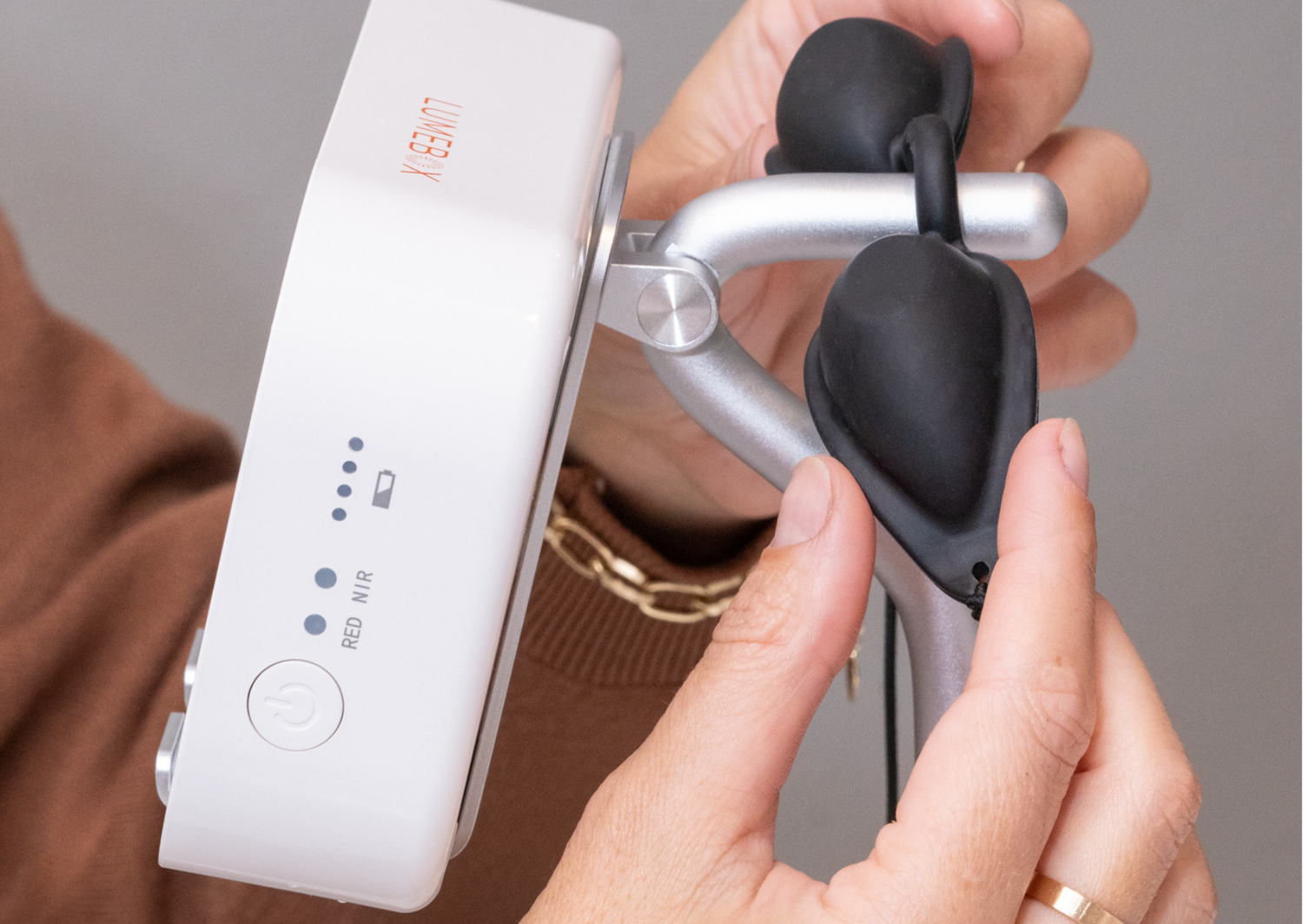
It’s important to note that NIR can be quite intense (especially when delivered through a high-irradiance device like LUMEBOX). This high power could be damaging to the eyes if you look at the intense light for too long, so it’s important to choose a device that includes protective goggles!
What are Mid-Infrared Light (MIR) and Far-Infrared Light (FIR)?
| Penetration depth: | 2-7 cm |
|---|---|
| Wavelength: | Mid-infrared 1400 - 3000 nmFar infrared 3000 nm– 0.1 mm |
| Typical use: | Infrared sauna |
Infrared light (IR), distinct from near-infrared light, has much longer wavelengths that penetrate deeply into the body. Its primary purpose is to heat the body and induce sweating, which is why it's commonly used in infrared saunas.
Unlike red light, IR does not support collagen or offer skin-related benefits. It also provides much less targeted pain and inflammation relief compared to NIR. However, if your goal is to sweat, mid- to far-infrared saunas are effective!
Why LUMEBOX?
Given the benefits discussed above, red light therapy offers huge potential for human health… and there’s still more exciting science emerging.
LUMEBOX:
… can emit both RED and NIR light from a single bulb
… can be used on multiple areas of the body (via the design and also the wavelength)
… is portable; full-body panels or red light therapy beds can be expensive, and you may find you use them less because it is harder to find time to use them, whereas LUMEBOX can be used anywhere.
How I use LUMEBOX
RED mode
Use case: Face, surface wounds, relaxation, and ambiance.
Distance: Hold 5-6 inches from the face (or target area). Remember your goggles if your eyes are in the beam window of light (the area where light is actively shining)!
Time: 6-minute cycle
NIR mode
Use case: Deeper muscle tissues and joints.
Distance: Hold closer to the skin, ensuring no clothing is between LUMEBOX and the body.
Time: 12-minute cycle
Combined mode
Use case: The best of both worlds!
Directions: Refer to our YouTube channel for detailed use notes!
Results take time
Results with red light therapy require patience. Red light therapy isn't a quick fix but is designed to enhance the body's natural processes. For instance, when using red light for skin improvements, changes become visible only after the deeper layers of skin cells rise to the surface, which could take between 6 and 8 weeks. While some individuals might notice mild effects shortly after beginning treatment, the most significant benefits are typically seen with consistent, prolonged use.
Ready to revitalize your health? Consider adding LUMEBOX to your self-care routine. It's a convenient and accessible way to experience the potential benefits of RLT in the comfort of your home.
FAQ
Does near-infrared light go deeper than red light?
Yes. Near-infrared wavelengths generally penetrate deeper than visible red wavelengths because longer wavelengths scatter less in tissue.
Is infrared sauna the same as red light therapy?
No. Infrared saunas mainly use heat-producing infrared wavelengths, while red light therapy uses red and near-infrared wavelengths aimed at photobiomodulation benefits like skin health, pain relief, and muscle recovery.
Which wavelength is best for skin?
Red light around 630–660 nm is most commonly studied for skin-related applications.
Which wavelength is best for pain?
Near-infrared light penetrates deeper than red light wavelengths, so it is most commonly studied for sub-surface applications like temporary pain relief or muscle recovery.
Can red and near-infrared light be used together?
Absolutely! While red and near-infrared light have their individual benefits, when in doubt, use them together (provided you have a device that offers combined mode). A lot of the benefits actually overlap, and you’ll find that the most common treatment approach in the science is using RED and NIR together.
Using combined mode for cellulite, muscle recovery, sleep, inflammation, wound healing, and more. For a more comprehensive overview, refer to our Kickstarter Guide, which is included with your first purchase of LUMEBOX.
New to red light therapy? Download our free eBook to help you choose the best device.
Already have a LUMEBOX? Download our 6 time-saving tricks guide!
Medical Disclaimer: The information contained in this blog post is intended for educational purposes only and should not be used as medical advice. Everyone responds to light differently. Testimonials are not a guarantee of the results you or anyone who uses LUMEBOX will get because your success depends entirely on your circumstances, and the studies on red light therapy shared were not specifically performed using LUMEBOX. Please check with your doctor before using red light therapy, and do not change your medical treatments or lifestyle without consulting your physician first.
References:
- Mester, E., Spiry, T., Szende, B., & Tota, J. G. (1971). Effect of laser rays on wound healing. The American Journal of Surgery, 122(4), 532-535. https://doi.org/10.1016/0002-9610(71)90482-X
- Hamblin M. R. (2017). Mechanisms and applications of the anti-inflammatory effects of photobiomodulation. AIMS biophysics, 4(3), 337–361. https://doi.org/10.3934/biophy.2017.3.337
- Lee, S. Y., Park, K. H., Choi, J. W., Kwon, J. K., Lee, D. R., Shin, M. S., Lee, J. S., You, C. E., & Park, M. Y. (2007). A prospective, randomized, placebo-controlled, double-blinded, and split-face clinical study on LED phototherapy for skin rejuvenation: clinical, profilometric, histologic, ultrastructural, and biochemical evaluations and comparison of three different treatment settings. Journal of photochemistry and photobiology. B, Biology, 88(1), 51–67. https://doi.org/10.1016/j.jphotobiol.2007.04.008
- Nam, C. H., Park, B. C., Kim, M. H., Choi, E. H., & Hong, S. P. (2017). The Efficacy and Safety of 660 nm and 411 to 777 nm Light-Emitting Devices for Treating Wrinkles. Dermatologic surgery : official publication for American Society for Dermatologic Surgery [et al.], 43(3), 371–380. https://doi.org/10.1097/DSS.0000000000000981
- Ng, J. N. C., Wanitphakdeedecha, R., & Yan, C. (2020). Efficacy of home-use light-emitting diode device at 637 and 854-nm for facial rejuvenation: A split-face pilot study. Journal of Cosmetic Dermatology, 19(9), 2288-2294. https://doi
- Migliardi, R., Tofani, F., & Donati, L. (2009). Non-invasive peri-orbital rejuvenation: radiofrequency dual radiowave energy source (RF) and light emission diode system (LED). Orbit (Amsterdam, Netherlands), 28(4), 214–218.
- Mavranezouli, I., Daly, C. H., Welton, N. J., Deshpande, S., Berg, L., Bromham, N., Arnold, S., Phillippo, D. M., Wilcock, J., Xu, J., Ravenscroft, J. C., Wood, D., Rafiq, M., Fou, L., Dworzynski, K., & Healy, E. (2022). A systematic review and network meta-analysis of topical pharmacological, oral pharmacological, physical and combined treatments for acne vulgaris. The British journal of dermatology, 187(5), 639–649. https://doi.org/10.1111/bjd.21739
- Nestor, M. S., Swenson, N., Macri, A., Manway, M., & Paparone, P. (2016). Efficacy and Tolerability of a Combined 445nm and 630nm Over-the-counter Light Therapy Mask with and without Topical Salicylic Acid versus Topical Benzoyl Peroxide for the Treatment of Mild-to-moderate Acne Vulgaris. The Journal of clinical and aesthetic dermatology, 9(3), 25–35.
- Liu, L. H., Fan, X., An, Y. X., Zhang, J., Wang, C. M., & Yang, R. Y. (2014). Randomized trial of three phototherapy methods for the treatment of acne vulgaris in Chinese patients. Photodermatology, photoimmunology & photomedicine, 30(5), 246–253. https://doi.org/10.1111/phpp.12098
- Na, J. I., & Suh, D. H. (2007). Red light phototherapy alone is effective for acne vulgaris: randomized, single-blinded clinical trial. Dermatologic surgery : official publication for American Society for Dermatologic Surgery [et al.], 33(10), 1228–1233. https://doi.org/10.1111/j.1524-4725.2007.33258.x
- Avci, P., Gupta, A., Sadasivam, M., Vecchio, D., Pam, Z., Pam, N., & Hamblin, M. R. (2013). Low-level laser (light) therapy (LLLT) in skin: stimulating, healing, restoring. Seminars in cutaneous medicine and surgery, 32(1), 41–52.
- Kleinpenning, M. M., Otero, M. E., van Erp, P. E., Gerritsen, M. J., & van de Kerkhof, P. C. (2012). Efficacy of blue light vs. red light in the treatment of psoriasis: a double-blind, randomized comparative study. Journal of the European Academy of Dermatology and Venereology : JEADV, 26(2), 219–225. https://doi.org/10.1111/j.1468-3083.2011.04039.x
- Ngoc, L. T. N., Moon, J.-Y., & Lee, Y.-C. (2022). Utilization of light-emitting diodes for skin therapy: Systematic review and meta-analysis. Photodermatology, Photoimmunology & Photomedicine. https://doi.org/10.1111/phpp.12841
- Perper, M., Eber, A., Lindsey, S. F., & Nouri, K. (2020). Blinded, Randomized, Controlled Trial Evaluating the Effects of Light-Emitting Diode Photomodulation on Lower Extremity Wounds Left to Heal by Secondary Intention. Dermatologic surgery : official publication for American Society for Dermatologic Surgery [et al.], 46(5), 605–611. https://doi.org/10.1097/DSS.0000000000002195
- Siqueira, C. P., de Paula Ramos, S., Gobbi, C. A., Shigaki, L., Kashimoto, R. K., Venâncio, E. J., de Oliveira Toginho Filho, D., Castaldin, A. G., Felinto, A. S., Silva, F. P., Silva, R. B., & Dias, I. F. (2015). Effects of weekly LED therapy at 625 nm on the treatment of chronic lower ulcers. Lasers in medical science, 30(1), 367–373. https://doi.org/10.1007/s10103-014-1666-5
- Nagai, N., Ayaki, M., Yanagawa, T., Hattori, A., Negishi, K., Mori, T., Nakamura, T. J., & Tsubota, K. (2019). Suppression of Blue Light at Night Ameliorates Metabolic Abnormalities by Controlling Circadian Rhythms. Investigative ophthalmology & visual science, 60(12), 3786–3793. https://doi.org/10.1167/iovs.19-27195
- Friedman S, Schnoor P. Novel Approach to Treating Androgenetic Alopecia in Females With Photobiomodulation (Low-Level Laser Therapy). Dermatol Surg. 2017 Jun;43(6):856-867. doi: 10.1097/DSS.0000000000001114. PMID: 28328705.
- Mai-Yi Fan S, Cheng YP, Lee MY, Lin SJ, Chiu HY. Efficacy and Safety of a Low-Level Light Therapy for Androgenetic Alopecia: A 24-Week, Randomized, Double-Blind, Self-Comparison, Sham Device-Controlled Trial. Dermatol Surg. 2018 Nov;44(11):1411-1420. doi: 10.1097/DSS.0000000000001577. PMID: 29957664.
- Pinto, H. D., Vanin, A. A., Miranda, E. F., Tomazoni, S. S., Johnson, D. S., Albuquerque-Pontes, G. M., Aleixo, I. O., Junior, Grandinetti, V. D., Casalechi, H. L., de Carvalho, P. T., & Leal-Junior, E. C. (2016). Photobiomodulation Therapy Improves Performance and Accelerates Recovery of High-Level Rugby Players in Field Test: A Randomized, Crossover, Double-Blind, Placebo-Controlled Clinical Study. Journal of strength and conditioning research, 30(12), 3329–3338. https://doi.org/10.1519/JSC.0000000000001439
- Leal Junior, E. C., Lopes-Martins, R. A., Rossi, R. P., De Marchi, T., Baroni, B. M., de Godoi, V., Marcos, R. L., Ramos, L., & Bjordal, J. M. (2009). Effect of cluster multi-diode light emitting diode therapy (LEDT) on exercise-induced skeletal muscle fatigue and skeletal muscle recovery in humans. Lasers in surgery and medicine, 41(8), 572–577. https://doi.org/10.1002/lsm.20810
- Ferraresi, C., Huang, Y. Y., & Hamblin, M. R. (2016). Photobiomodulation in human muscle tissue: an advantage in sports performance?. Journal of biophotonics, 9(11-12), 1273–1299. https://doi.org/10.1002/jbio.201600176
- Douris, P., Southard, V., Ferrigi, R., Grauer, J., Katz, D., Nascimento, C., & Podbielski, P. (2006). Effect of phototherapy on delayed onset muscle soreness. Photomedicine and laser surgery, 24(3), 377–382. https://doi.org/10.1089/pho.2006.24.377
- Zhao, J., Tian, Y., Nie, J., Xu, J., & Liu, D. (2012). Red light and the sleep quality and endurance performance of Chinese female basketball players. Journal of athletic training, 47(6), 673–678. https://doi.org/10.4085/1062-6050-47.6.08
- Chang, W. D., Wu, J. H., Wang, H. J., & Jiang, J. A. (2014). Therapeutic outcomes of low-level laser therapy for closed bone fracture in the human wrist and hand. Photomedicine and laser surgery, 32(4), 212–218. https://doi.org/10.1089/pho.2012.3398
- Stelian J, Gil I, Habot B, Rosenthal M, Abramovici I, Kutok N, Khahil A. Improvement of pain and disability in elderly patients with degenerative osteoarthritis of the knee treated with narrow-band light therapy. J Am Geriatr Soc. 1992 Jan;40(1):23-6. doi: 10.1111/j.1532-5415.1992.tb01824.x. PMID: 1727843.
- Ganjeh, S., Rezaeian, Z.S. & Mostamand, J. Low Level Laser Therapy in Knee Osteoarthritis: A Narrative Review. Adv Ther 37, 3433–3449 (2020). https://doi.org/10.1007/s12325-020-01415-w
- Mak, M. C., & Cheing, G. L. (2012). Immediate effects of monochromatic infrared energy on microcirculation in healthy subjects. Photomedicine and laser surgery, 30(4), 193–199. https://doi.org/10.1089/pho.2011.3012
- Hamblin M. R. (2017). Mechanisms and applications of the anti-inflammatory effects of photobiomodulation. AIMS biophysics, 4(3), 337–361. https://doi.org/10.3934/biophy.2017.3.337
- Minatel, D. G., Frade, M. A., França, S. C., & Enwemeka, C. S. (2009). Phototherapy promotes healing of chronic diabetic leg ulcers that failed to respond to other therapies. Lasers in surgery and medicine, 41(6), 433–441. https://doi.org/10.1002/lsm.20789
- Chen, Y., Chen, X. L., Zou, X. L., Chen, S. Z., Zou, J., & Wang, Y. (2019). Efficacy of low-level laser therapy in pain management after root canal treatment or retreatment: a systematic review. Lasers in medical science, 34(7), 1305–1316. https://doi.org/10.1007/s10103-019-02793-6
- Asnaashari, M., Mojahedi, S. M., Asadi, Z., Azari-Marhabi, S., & Maleki, A. (2016). A comparison of the antibacterial activity of the two methods of photodynamic therapy (using diode laser 810 nm and LED lamp 630 nm) against Enterococcus faecalis in extracted human anterior teeth. Photodiagnosis and photodynamic therapy, 13, 233–237. https://doi.org/10.1016/j.pdpdt.2015.07.171
- Paolillo, F. R., Borghi-Silva, A., Parizotto, N. A., Kurachi, C., & Bagnato, V. S. (2011). New treatment of cellulite with infrared-LED illumination applied during high-intensity treadmill training. Journal of Cosmetic and Laser Therapy, 13(3), 166–171. https://doi.org/10.3109/14764172.2011.594065


